

Visits
Tours
We are in the process of creating several walking tours designed for all ages and interests. These will include:
- History and heritage (highlights included below)
- Family Discovery Trail – NOW AVAILABLE for a small donation during our events. Please contact us to find out more.
- Trees, biodiversity, and nature (coming soon)
- Sculptures and symbolism (coming soon)
- Mindfulness walks (coming soon)
History and heritage tour highlights
- Ellen Spratt (30 June 1877). Lacking a gravestone, the first burial at the cemetery is unmarked but can be found under a tree close to the Service Chapel on the left (as you approach from the front gate). SECTION E
- Double chapel and spire (constructed 1876-1877). Spans across SECTIONS E and G
- Harry Bloom (1913-1981). Bloom was a South African journalist and novelist who challenged the apartheid system and was exiled to the UK in 1963. His second wife, Sonia, is the mother of the actor Orlando Bloom. SECTION N
- Joseph Conrad (1857-1924). Born Józef Teodor Konrad Korzeniowski, this international writer is perhaps best known as the author of Lord Jim, Nostromo, and Heart of Darkness (the loose inspiration for the 1979 film, Apocalypse Now). His memorial is officially registered as a Grade II listed building with Historic England. SECTION N
- Private Thomas Byrne VC (1866-1944). Byrne was born in Dublin and won his VC at the Battle of Omdurman, Sudan, in 1898. He later fought in the Boer War and lived from 1914 to 1944 in Notley Street, where his home is marked with a blue plaque. SECTION MJ
- Cross of Sacrifice. The Cross of Sacrifice is a Commonwealth war memorial that is present in Commonwealth war cemeteries containing 40 or more graves. SECTION V
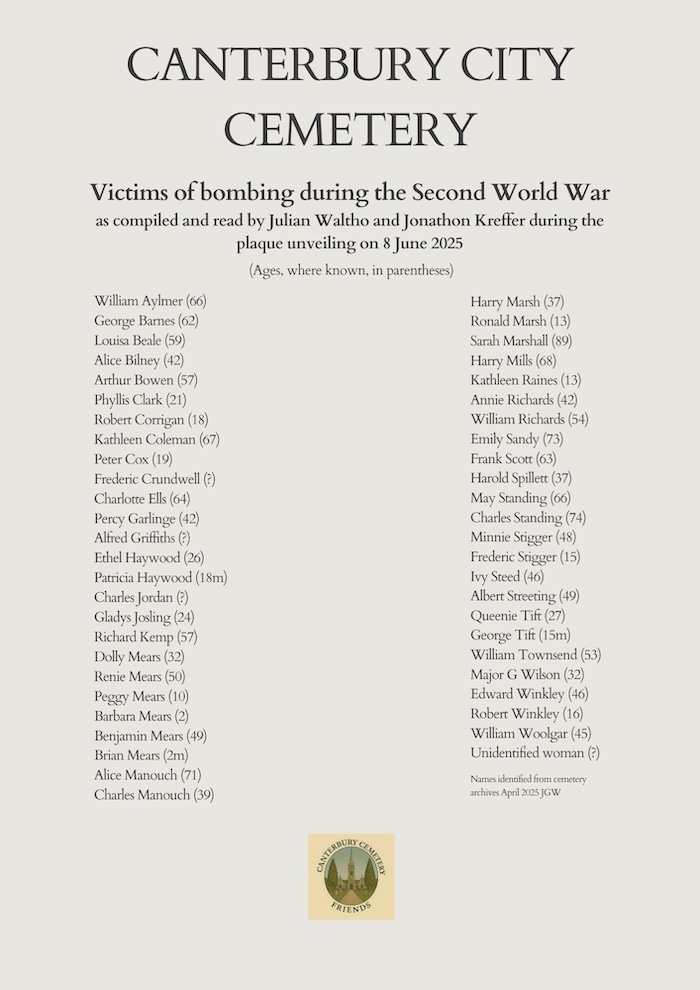
- Civilian victims of the Blitz in Canterbury. This area serves as the resting place for the Canterbury civilians killed in 1942 during the Baedecker air raids. SECTION XM
- C. (Cyril) Northcote Parkinson (1909-1993). Parkinson was a British naval historian and the author of some 60 books, the most famous of which was his best-seller Parkinson’s Law (1957), in which he advanced the eponymous law stating that “work expands so as to fill the time available for its completion”. He lived at 36 Harkness Drive, where his home is marked with a blue plaque. SECTION XH
- Memorial to the unknown citizens of Canterbury (2002). These unknown citizens were buried in the churchyard of the original St Mary Bredin Church, which was founded in the 12th century, rebuilt in 1867, and destroyed in 1942 by enemy bombs. The remains of the citizens were removed during the redevelopment of the Whitefriars shopping centre and reburied in the cemetery in 2002. SECTION XL
- Second World War Military Graves. Counts vary, but one estimate is that there are 54 World War II graves. SECTION XM
- First World War Military Graves. Again, counts vary, but it is estimated that there are 146 World War I graves. SECTION B
- Henry Dickinson, Jedi Knight (1978-1998). His grave is inscribed with the quote from the opening sequence of the Star Wars series of films, “In a galaxy far, far away”. SECTION V
History and biodiversity bonus:
Descendant trees of the silver lime tree. These trees commemorate the death of General Charles Gordon in 1885. SECTION B
Click this link to explore the FULL SCREEN interactive version of this history and heritage tour, including more details about the highlights.
CREDIT: This map is based on research provided by Brian McHenry on behalf of the Heritage and History Committee for the Canterbury Cemetery Friends. We acknowledge the assistance of the Canterbury Historical and Archaeological Society for some information in these notes.


Expand the icon above to see photos of some selections from the history and heritage walking tour.