Canterbury City Cemetery is full of historical interest, having opened in Victorian times.
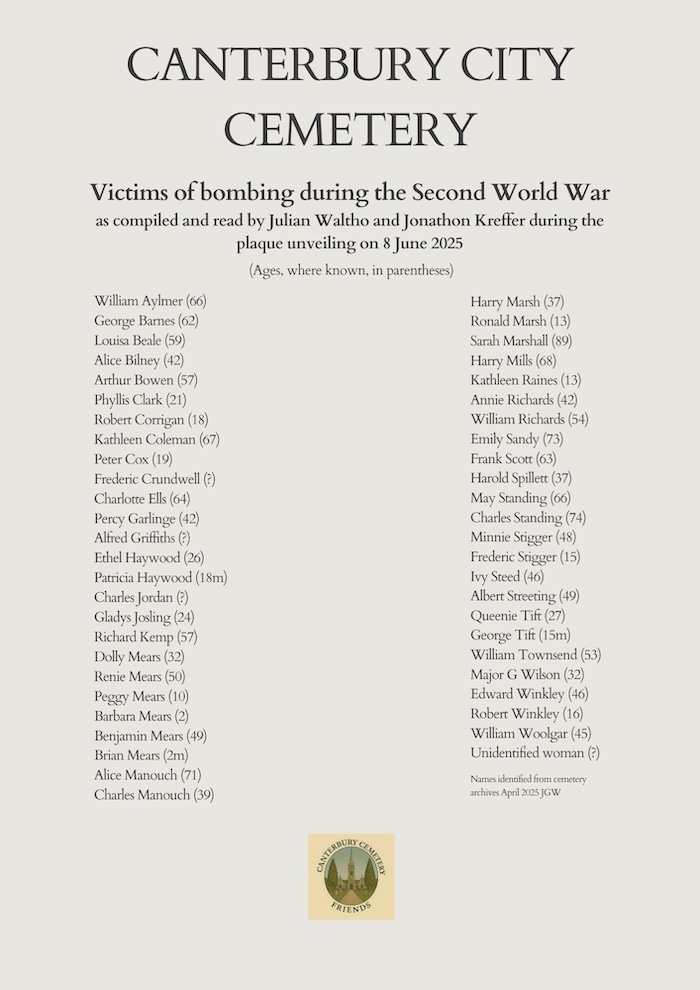
The war dead are recalled by poignant memorials — both to soldiers who fell in the World Wars and the Canterbury civilians killed in the 1942 Baedecker air raids. This series of attacks undertaken by the Luftwaffe targeted historic sites around the country, including Canterbury, where hundreds of people were killed and injured during the bombing campaigns that took place.
In addition, the cemetery holds the graves of a number of famous individuals, including the great writer Joseph Conrad. His memorial, noted for its architectural and historic interest, is on Historic England’s National Heritage List as a Grade II listed building.
Three timelines below offer highlights from the cemetery’s legacy — accompanying photos add to the story and strengthen connections to the past.
Canterbury City Cemetery:
1876 to 1900
During the Victorian period, Canterbury’s need for additional burial space prompted the development of a new cemetery. This came following legislation in the mid-1800s to regulate burial grounds and address overcrowding in church graveyards. It also acknowledged the increased awareness of urban sanitation concerns that arose after outbreaks of infectious diseases. This portion of the timeline highlights important milestones that took place in these early years.
3 March 1876: Original plans for Canterbury City Cemetery are submitted by Mr John Green Hall, architect. The site plan includes twin cemetery chapels, mortuary, hearse house, porter/curator’s lodge, and more. Building specifications requested and advertisement for tenders prepared. (Source: Historic Canterbury.)

This is one of the original buildings on the site. 16 June 1876: Plan submitted by Mr Hall, who was also the borough surveyor, is agreed; the tender of Mr HB Wilson is accepted. (Source: Historic Canterbury.)
30 June 1877: Ellen Spratt is the first person buried in the cemetery. There is no tribute or headstone to mark her grave, which is located in Section E.

4 July 1877: Canterbury City Cemetery officially opens. At this point, approximately half of the ground is consecrated, and a portion of the remaining half is set aside for consecration at a later date. The rest of the unconsecrated portion is allocated for Nonconformists and other religions and beliefs.

Could this be Queen Bertha peeking from the corner above the arch? Between the ragstone chapels is an arch topped with an elegant spire that reflects Canterbury’s status as a historic city. There are small stone heads positioned at the entry between the chapels; these are thought to be images of Queen Bertha (pictured above) and King Ethelbert of Kent.

The spire between the twin decorated chapels is one of the cemetery’s elegant architectural highlights. The chapel on the left (as visitors approach from the main entrance) is the Service Chapel. That on the right is the Remembrance Chapel, which has never been used. However, there is a Book of Remembrance in an anteroom of the Remembrance Chapel.
The project cost £9,000 and is intended to be both functional and aesthetically dignified.
26 January 1885: General Charles Gordon is killed in Khartoum, Sudan, after a 10-month siege by enemy forces. Funeral services take place around the country on 13 March 1885, and a silver lime tree is planted in the cemetery to commemorate the death of this distinguished military leader. Many descendants of the original tree thrive nearby, but the original tree has not survived. Its location is marked by the memorial plaque.

The lush growth surrounds the plaque that indicates where the original commemorative lime tree for General Gordon once stood. 1889: Cemetery opens to the public daily and on Sundays from noon until sunset. (Source: Historic Canterbury.)
6 January 1899: Private Thomas Byrne of the 21st Lancers receives the Victoria Cross (VC) for his bravery during the Battle of Omdurman, Sudan on 2 September 1898. Born in Dublin in 1866, Byrne lived in Canterbury from 1914 until his death on 17 February 1944. He is buried in SECTION MJ. His home on Notley Street is marked with a blue plaque. (Source: VictoriaCross.org.uk/bbbyrnet.htm.)
Canterbury City Cemetery:
1901 to 1950
The first half of the new century brings with it the end of the Victorian age. It ushers in a period of global growth and prosperity driven by ongoing industrial expansion. However, the era is also marked by several international conflicts followed by periods of great national mourning as well as significant local tragedy. This middle portion of the timeline covers key dates and events that took place during these decades.
22 January 1901: Queen Victoria dies.
4 August 1914: After the assassination of Archduke Franz Ferdinand on 28 June 1914, Britain declares war on Germany. This date marks the country’s entry into the conflict known as The Great War or World War I.
26 October 1915: Private Alec Grigg of The Buffs (East Kent Regiment) becomes a casualty of the First World War at the age of 14 (although he states he is 19 in order to enlist). The Sittingbourne resident never sees military action and dies either from blood poisoning or tetanus (referred to in some contemporary accounts as lockjaw) from a cut he gives himself when fixing badges to another soldier’s uniform. He is thought to be the youngest soldier to die in the First World War. (Source: Commonwealth War Graves Commission.)
1923: Eight acres are added to the original 12-acre cemetery site to meet the demands of the community. The increase comes in the aftermath of the First World War (which ended in 1918 and may have resulted in 146 CWGC graves), and is followed by the outbreak of the Spanish flu pandemic that begins in 1918 (and causes more than 200,000 deaths across the United Kingdom).

Detail from the Cross of Sacrifice. This is also when the cemetery incorporates war graves and memorials, such as the Cross of Sacrifice (detail pictured above), to highlight its role in commemorating collective history.

3 August 1924: Joseph Conrad (Józef Teodor Konrad Korzeniowski), the world famous author, dies in Bishopsbourne and is buried in Canterbury City Cemetery. Born on 3 December 1857 in what is now Ukraine, the young Conrad pursues a career at sea before he becomes a British subject in 1886. He writes several intense and evocative pieces of fiction, but he must abandon life at sea due to health issues.
In 1896, Conrad marries a modest Englishwoman and begins life with his wife and sons in the countryside. Eventually, Conrad and his family settle in Kent, where he dies at the age of 66.
1 September 1939: The invasion of Poland by German military forces triggers an ultimatum from the British government which is disregarded. On 3 September, Britain declares war on Germany, and the Second World War begins.
20 April 1941: Kathleen Rosa Raines of Sturry Road is killed by enemy activity during a raid. Only 13 years old, the girl is believed to be one of the youngest of all Canterbury civilians killed during the Second World War.
Her grave is pictured below.

You can read more about Kathleen and some of the other victims in this article by Gerry Warren in KentOnline: Full story of how German bombing killed so many civilians during Second World War now displayed on new plaque at Canterbury Cemetery.
1942: A series of deadly attacks by the German Air Force targets historic cathedral cities across the country, including Canterbury, Exeter, Bath, Norwich, and York. The locations are said to be selected not because they are strategic factories, military bases, or ports, but because they are significant landmarks that serve to boost the country’s morale and preserve its history. Referred to as the Baedeker raids (after the German travel guides), the attacks hit Canterbury at the end of May/beginning of June and again at the end of October. Many of the individuals killed during the raids are buried in Canterbury City Cemetery in a row of graves in SECTION XM, although others are located in different parts of the cemetery.
Canterbury City Cemetery:
1951 to the present
Despite being associated with the past, the cemetery continues to experience phases of renewal and growth. During this stage of the cemetery’s development, tributes are refreshed and rejuvenated, the natural landscape matures, and portions of the site are dedicated to different groups and communities that are part of the fabric of the area.
19 November 1955: Cyril Northcote Parkinson publishes an essay in The Economist with the tongue-in-cheek observation, “work expands so as to fill the time available for its completion”. This commonly becomes referred to as Parkinson’s law which later becomes a popular book (published in 1957) and makes Parkinson an international celebrity. He dies in Canterbury in March 1993 at the age of 83.

Parkinson’s headstone was restored and secured in the summer of 2025. 1993: The Babies Garden opens as a place where infants can be buried individually and in their own dedicated area. It is officially launched in September 1995 with the unveiling of a tree mosaic created by local art student Donna Fleming (pictured below, left), together with a plaque engraved with her poem, The Tree.
A few years later, the mosaic, damaged by frost, is replaced by a heart-shaped sculpture representing a parent and child (pictured below, right). It is installed on the same spot and inscribed, like the original, with the dedication, ‘Our children forever in our hearts’.


1996: Joseph Conrad’s grave receives designation as a Grade II listed structure despite the misspelling — Joseph Teador Conrad Korzeniowski instead of Józef Teodor Konrad Korzeniowski.

15 May 2002: During the development of Whitefriars shopping centre in Canterbury, the remains of unknown individuals once buried in the nearby graveyard of the St Mary Bredin Church in Rose Lane (destroyed during the Baedeker Raids in 1942) are moved from the area that is now the Marlowe shopping arcade. An engraved headstone is placed in their memory to indicate where they have been reinterred in Canterbury City Cemetery.

2019: The Commonwealth War Graves Commission (CWGC) updates the headstone of Private Alec Grigg (pictured below) with his correct age, changing it to show he was 14 (not 19) when he died during the First World War. (Source: Commonwealth War Graves Commission.)

2024: To mark the 100th anniversary of Conrad’s death, a commemorative information board (pictured below) is placed in front of his grave.

7 October 2024: A group of local individuals with an interest in the cemetery holds a meeting “to introduce the rich and varied life of this great open space and to discuss the idea of setting up a group of Friends of the Canterbury Cemetery.” (Source: The Canterbury Society.)

May 2025: An information board commemorating the Canterbury Second World War Blitz victims is placed in an area close to the graves of many of the victims. The official unveiling, which includes the reading of the names of all of the victims, takes place on 8 June 2025.

21 September 2025: The Canterbury Cemetery Friends hold an Open Day event. In addition to giving guests the rare chance to peek inside the unused chapel, the day features guided tours on trees, history, and biodiversity. The tours end with spontaneous applause from appreciative attendees, and the event is a tremendous success under skies that eventually brighten up and stay dry.